AI Mobile Health Lab
AI모바일헬스 연구실
Junhyung Moon, Assistant Professor · Software Convergence Major, College of Healthcare Convergence
Mobile healthWearable sensingStress recognitionMedical AI
About the Lab
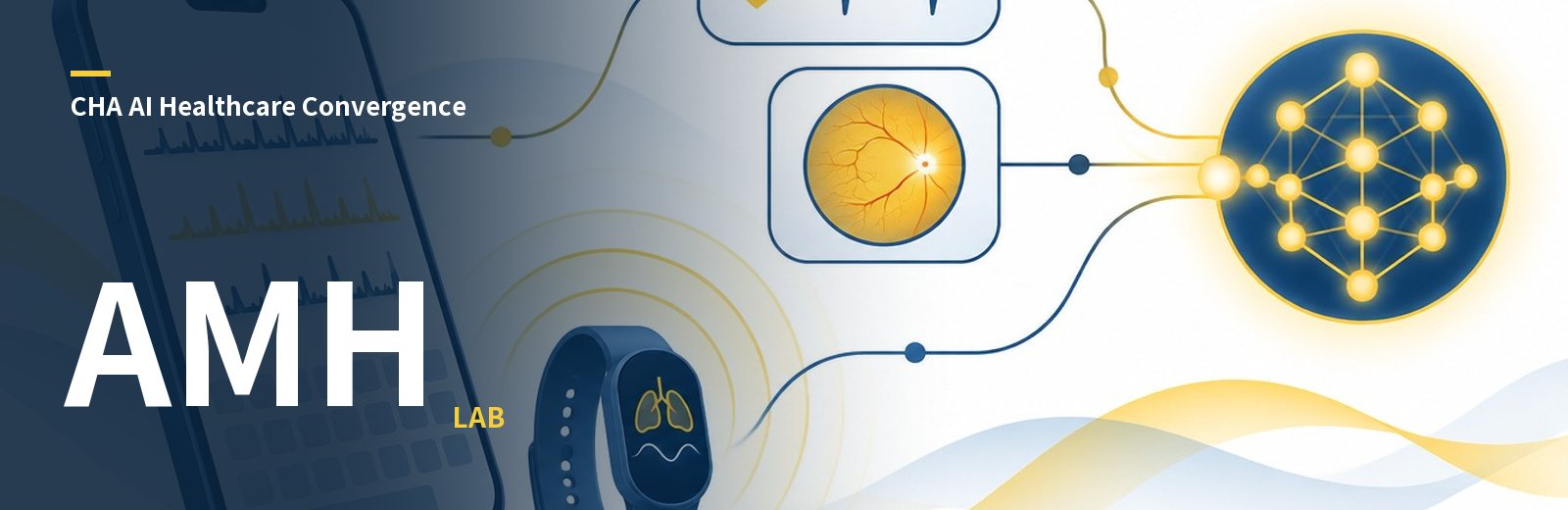
The AI Mobile Health Lab is led by Prof. Junhyung Moon of the Software Convergence Major in the College of Healthcare Convergence, and it uses artificial intelligence to estimate health status from signals that smartphones and wearable devices collect in daily life. The lab has estimated age from smartphone keystroke patterns, recognized mental stress from respiration and movement signals, and built wearable systems that monitor pediatric nocturnal enuresis and voiding function at home. It also conducts medical AI research on hospital clinical data, including models that predict the recurrence of wet age-related macular degeneration from retinal images and a diagnostic support system for patent ductus arteriosus in premature infants. Prof. Moon received his B.S. and Ph.D. in Computer Science from Yonsei University and won the Best Paper Award at ACM CHI 2025.
Research Areas
- 01
Digital biomarkers that estimate age and health status from smartphone keystrokes and usage logs with AI
- 02
Contactless recognition of mental stress from respiration, movement and radar signals
- 03
In-home monitoring and rehabilitation support for enuresis and voiding dysfunction with wearables and mobile apps
- 04
AI for disease recurrence prediction and diagnostic support from retinal images and clinical data
Research Plans
- 01
AI-related research
Privacy-preserving prediction of multiple diseases with zero-shot learning, and AI for epileptic seizure detection and rehabilitation prognosis
- 02
Joint AI research
Joint papers, patents and research projects with the AI Predictive Analytics Lab of the department chair, applying AI methods to the lab's data and research questions
Joint outcomes will be added to the research output on this page
Research Output
Selected Publications12
- 2026, Uncertainty-Aware Selective Prediction of Neovascular Age-Related Macular Degeneration Recurrence Using Artificial Intelligence, IEEE Access
- 2026, Designing an mHealth App for Defecatory Function Rehabilitation of Post-Surgical Colorectal Cancer Survivors, Journal of Healthcare Informatics Research
- 2026, Association between Complete Blood Cell Count (CBC)-Derived Inflammatory Markers and Natural Killer Cell Activity: A Cross-Sectional Study, Journal of Inflammation Research
- 2025, Exploring Age-Related Patterns in Smartphone Keystroke Dynamics Considering Temporal Variability: Cross-Sectional Study with AI-Based Analysis, JMIR mHealth and uHealth
- 2025, FluidTrack: Investigating Child-Parent Collaborative Tracking for Pediatric Voiding Dysfunction Management, ACM CHI Conference on Human Factors in Computing Systems (CHI 2025)
- 2025, Predicting Wet Age-Related Macular Degeneration Recurrence Using CNN Models with Multimodal Retinal Imaging, Digital Health Research
- 2024, Association between Resting Heart Rate and Low Natural Killer Cell Activity: A Cross-sectional Study, Frontiers in Immunology
- 2024, Wearable-Based Integrated System for In-Home Monitoring and Analysis of Nocturnal Enuresis, Sensors
- 2024, Artificial Intelligence-based Diagnostic Support System for Patent Ductus Arteriosus in Premature Infants, Journal of Clinical Medicine
- 2023, Intelligent Estimation of Exercise Induced Energy Expenditure Including Excess Post-Exercise Oxygen Consumption (EPOC) with Different Exercise Intensity, Sensors
- 2021, Continuous Body Impedance Measurement to Detect Bladder Volume Changes during Urodynamic Study: a Prospective Study in Pediatric Patients, Neurourology and Urodynamics
- 2019, Stress Recognition with State Classification Considering Temporal Variation of Stress Responses, IEEE International Conference on Bioinformatics and Biomedicine
Patents
- 2021, Contactless stress inference device and method using a UWB (Ultra-Wideband) radar sensor, Korean patent (registered)
- 2021, Device for recognizing a presenter's mental stress and providing feedback, Korean patent (registered)
- 2020, Voiding prediction device and voiding prediction method, Korean patent (registered)
Research Projects
- Privacy-preserving prediction of multiple diseases using zero-shot learning (Ministry of Science and ICT · IITP, Digital Columbus Project, 2024.04–2032.12, Principal Investigator)
- AI technology for epileptic seizure detection and rehabilitation prognosis prediction (Ministry of Science and ICT · NRF, Sejong Science Fellowship, 2024.05–2029.04, Principal Investigator)
Awards
- 2025, Best Paper Award, ACM CHI Conference on Human Factors in Computing Systems
- 2019, NAVER Ph.D. Fellowship Award
Profile
Education
- Ph.D. in Computer Science, Yonsei University
- B.S. in Computer Science, Yonsei University
Career
- Present: Assistant Professor, Software Convergence Major, College of Healthcare Convergence, CHA University
- Former: Research Professor, Department of Biomedical Informatics, CHA University School of Medicine
- Former: Postdoctoral Researcher, University of Maryland, College Park
- Former: Postdoctoral Researcher, Department of Computer Science, Yonsei University
People
Join the Lab
- Admission for master's and doctoral programs, Spring 2027
- 50% tuition scholarship for every full-time student regardless of undergraduate institution; 25% for part-time students employed by CHA Medical Group
- Research and teaching assistantships and support for international journal publication fees